Flight Release Wizard
Saved the airline millions in regulatory fines by transforming its error-prone flight release process into a resilient, automated compliance workflow.
WORKFLOW OPTIMIZATION

Timeframe
10 weeks
Users
Flight Dispatchers
Industry
Aviation

//the stakes
A flight release is a mandatory authorization procedure executed by dispatchers that verifies all safety and operational conditions before departure.
Before any commercial flight departs, a dispatcher must execute a flight release. Its a legally binding authorization that confirms every safety and operational condition has been verified. It's a sign-off with legal weight.
Dispatchers carry this responsibility for dozens of flights per shift, under time pressure, with departure windows that don't move. Every one of these must be confirmed before departure. A missed item isn't a minor oversight, its a regulatory violation and in the worst case, a safety event.
//the problem
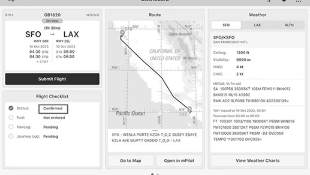
The airline's legacy flight release workflow required dispatchers to manually check data across five separate tools, none of which were designed to work together. Every release meant switching between systems, reconciling conflicting information, and reconstructing a complete operational picture by hand.
Post-COVID operating conditions increased pressure on an already fragile workflow. The airline began accumulating costly fines from regulatory violations because the tools made the job impossible to do reliably.
fewer submission
errors
faster release
cycles
automated validation
checks
TASK SUCCESS
I evaluated how accurately dispatchers complete the wizard.
TASK SUCCESS
I evaluated how long it takes for dispatchers to complete a flight releases.
SATISFACTION & TRUST
I measured dispatcher's overall satisfaction level of the experience.
Key metrics included time-on-task, error rate, and SUS (System Usability Scale) to evaluate improvements in efficiency, accuracy, and dispatcher confidence.
Identifying the Issue in the Current Workflow
COMPLIANCE AUDIT
CONTEXTUAL INQUIRY
JOURNEY MAPPING
Compliance Audit
I audited past flight releases to establish a quantitative baseline. The analysis revealed an 8% error rate — confirming that the existing workflow posed a measurable compliance and operational risk, not just a usability inconvenience.
Contextual Inquiry
To understand why errors were occurring, I spent three days embedded with five flight dispatchers in their live working environment. I observed them managing competing demands — phone calls, multiple monitors, dozens of browser tabs — all while manually copying and validating data across five disconnected tools.
Journey Mapping
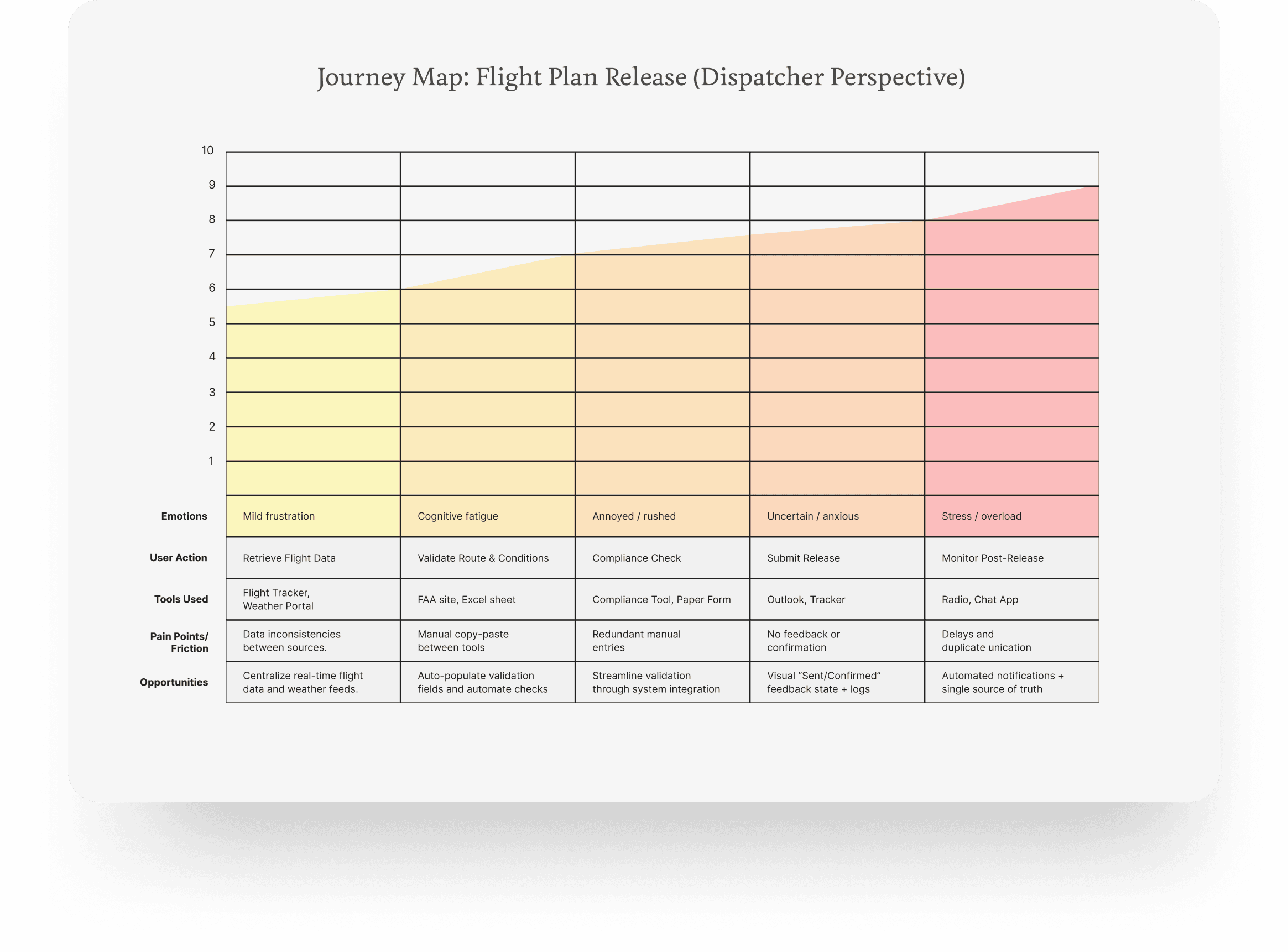
I synthesized the observations into a journey map of the full dispatcher experience. It confirmed why a single flight release took an average of 45 minutes — exposing repetitive validation steps, manual handoffs, and a friction curve that peaked at the most compliance-critical moments.
Research Insights: Fragmentation & Cognitive Load
Quantitatively, this breakdown manifested in an 8% error rate, an average 45-minute time on task per flight release, and a SUS score of 35, indicating poor usability.
The research revealed that dispatchers were operating under extreme time pressure. They were manually cross-referencing data across five disconnected systems including weather, fuel plans, and NOTAMs. The fragmentation of tools and manual data transfers was a primary driver of critical errors and cognitive fatigue.
Engineering a New Workflow
FLOW DIAGRAMMING
SKETCHING
PROTOTYPING
With a clear view of the problem, the next question was how to translate research insights into a solution that reduced cognitive load and made compliance feel automatic rather than burdensome.
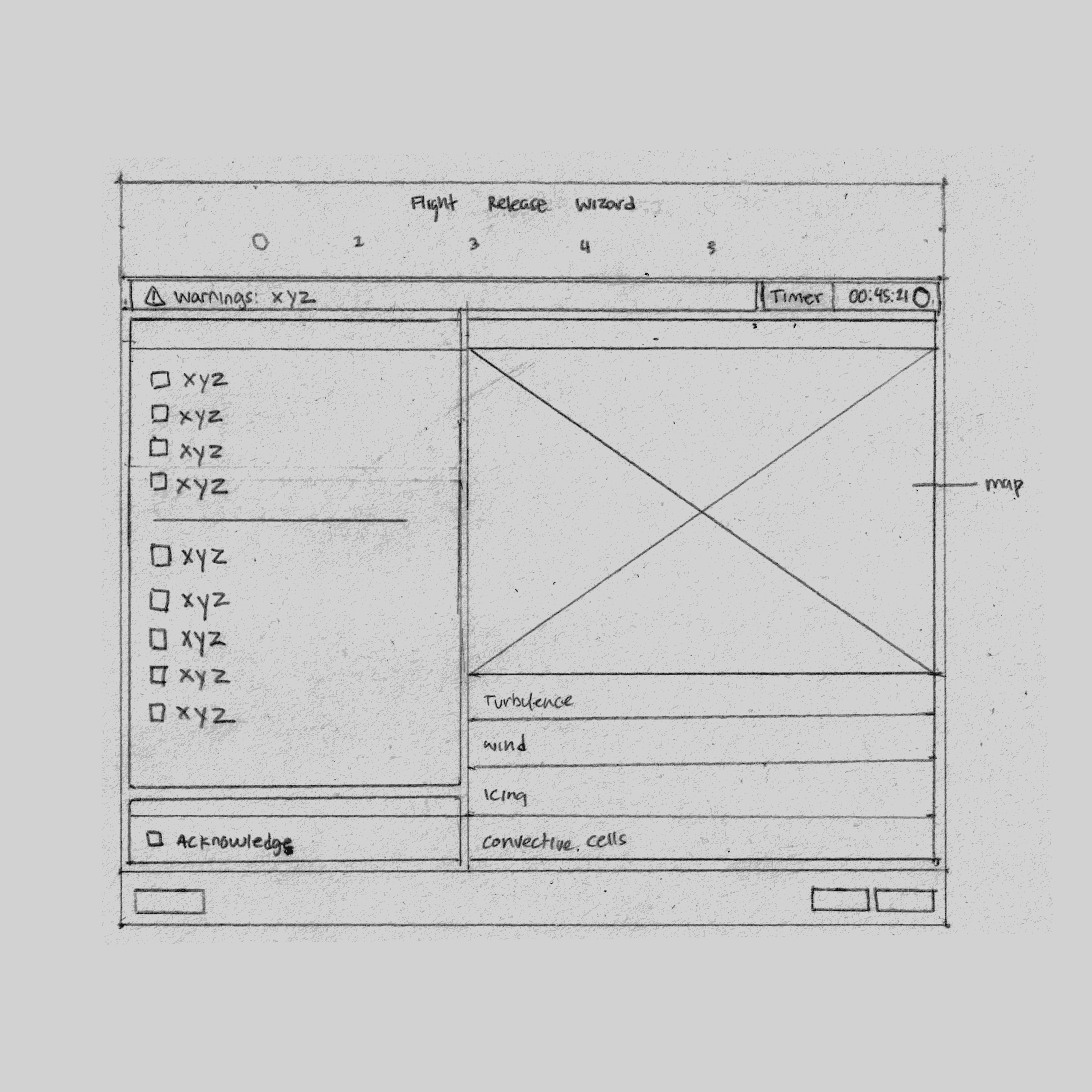
I distilled the key pain points and opportunity areas into a prioritized feature set, then explored how those features could reshape the dispatcher workflow through flow diagrams, sketches, wireframes, and interactive prototypes.
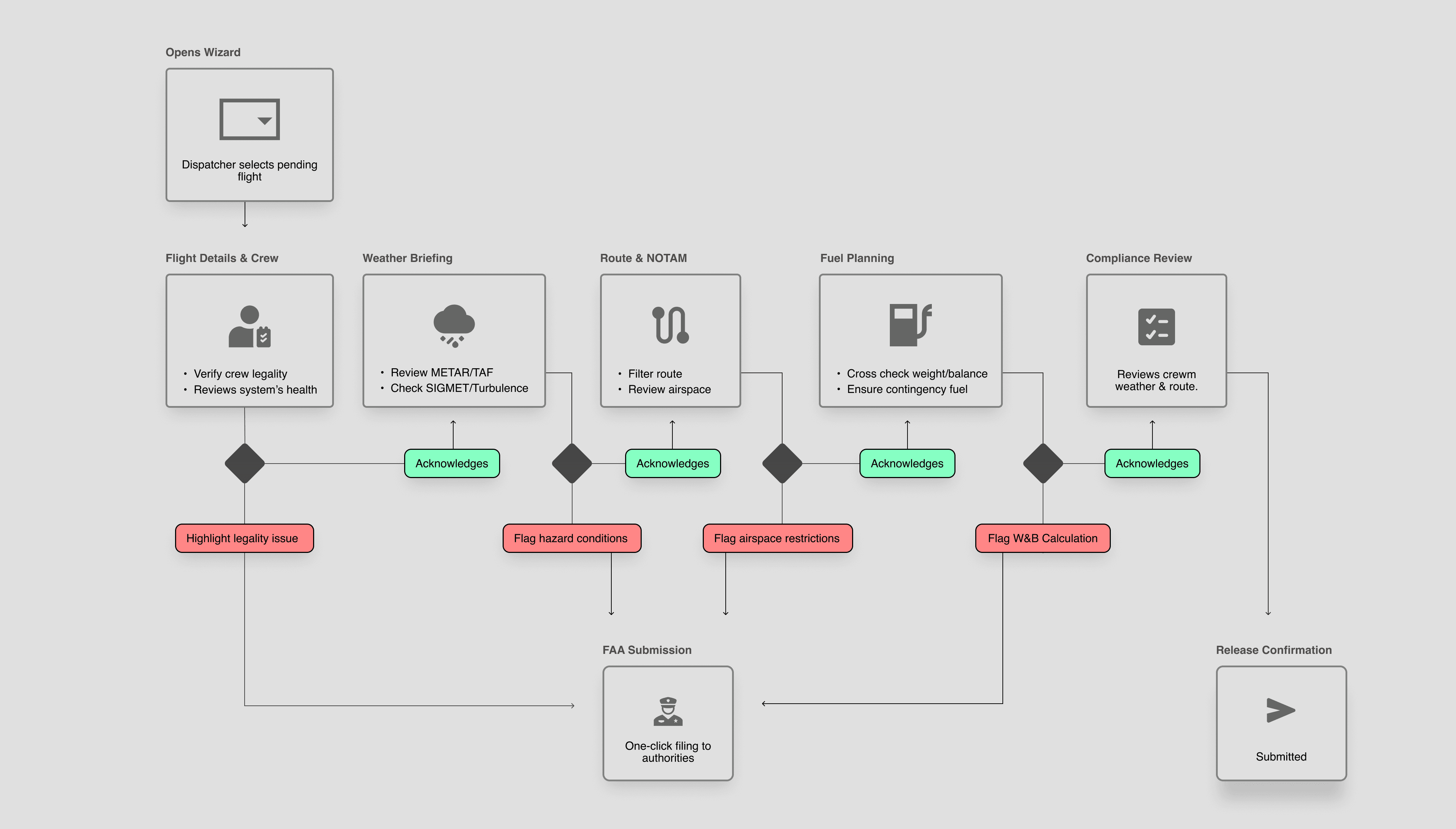
Flow diagramming: The ideal path represents the intended, uninterrupted workflow. In this flow, dispatchers move through each step: flight details, weather, route and NOTAMs, fuel planning, and final compliance review - acknowledging system checks as they go.


Outcome: Setting a New Operational Standard
The Flight Release Wizard reduced the error rate from 8% to 2%, cut average time on task from 45 minutes to 17 minutes, and raised the SUS score from 35 to 87.
This represents a systemic reduction in cognitive load and compliance risk. Dispatchers work faster, with greater confidence, in a system that finally matches the complexity of the job it supports.
The fines stopped. The errors dropped. The workflow that once took 45 minutes now takes 17. And the dispatchers who were managing five disconnected tools now have one.
(from 8%)
(from 45 min)
(from 45 min)
From product definition through final release, I collaborated directly with Flight Operations to build a wizard that consolidates five fragmented data sources into a single source of truth. The design is rooted in three principles:
Consolidation — one place for everything.
Automation — the system handles what it can.
Trust — dispatchers always know where they stand.
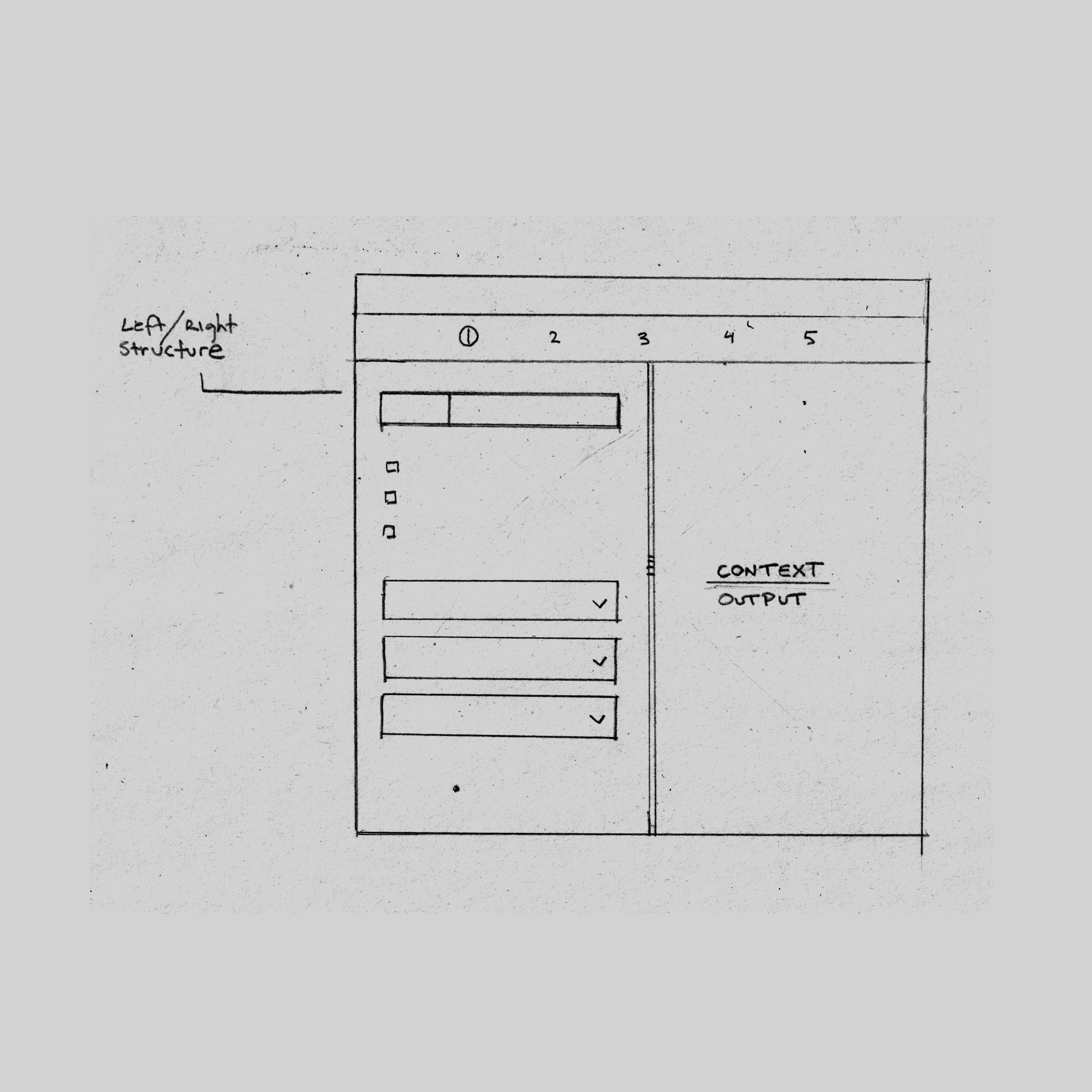
01. Command + Context Structure
One workspace. Every decision.

A single workspace that pairs dispatcher actions with real-time operational context — route data, crew legality, weather, and compliance state all visible in one place. The five-system fragmentation that was driving errors is eliminated at the structural level.
Rationale:
The biggest source of cognitive load wasn't any single task — it was the constant context-switching between tools. Consolidating everything into one workspace didn't just reduce friction, it removed the condition that made errors likely in the first place.
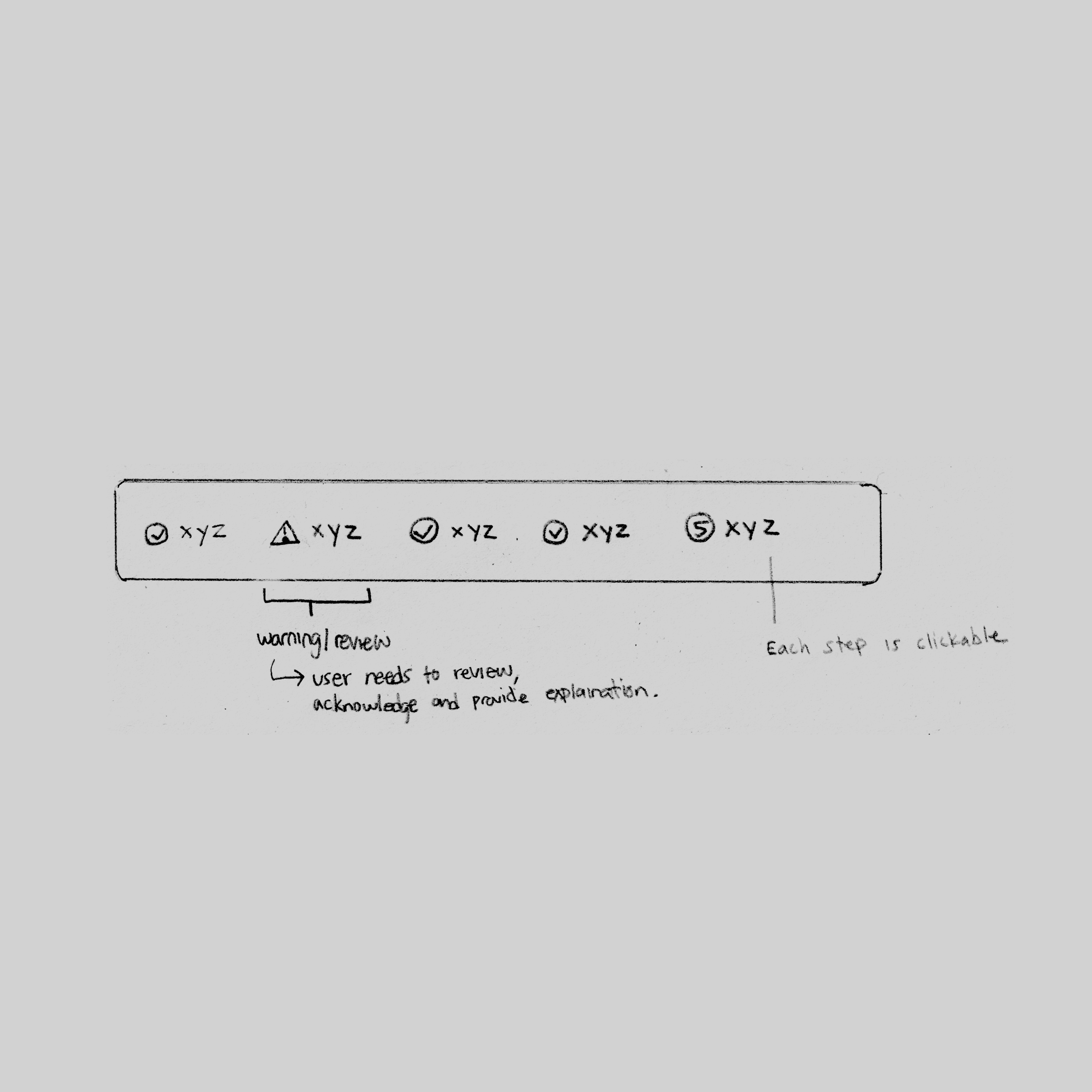
02. Auto-Population + Status-Based Steppers
The system does the work. The dispatcher makes the call.

Searching a flight instantly loads route, aircraft, crew, and current compliance state. Each step visually reflects completion, warnings, or blocking issues via Green / Amber / Red steppers. Dispatchers always know their compliance state before moving forward.
Rationale:
Auto-population eliminates the manual cross-referencing that was causing the 8% error rate. The steppers replace the mental checklist dispatchers were maintaining in their heads — making system state visible rather than assumed. These two features work together: one removes the data entry burden, the other makes the result legible.
03. AI Assist for Route Options
AI surfaces options. Dispatchers decide.

When evaluating routes, AI surfaces compliant alternatives based on weather, NOTAMs, and operational constraints. Dispatchers see the options ranked by compliance and efficiency — they don't have to reconstruct the logic manually across three separate systems.
Rationale:
Route evaluation was the most time-consuming and error-prone step in the legacy workflow. Dispatchers were switching between a weather portal, an FAA site, and an Excel sheet to manually verify each option. The AI doesn't make the decision — it assembles the evidence so the dispatcher can.
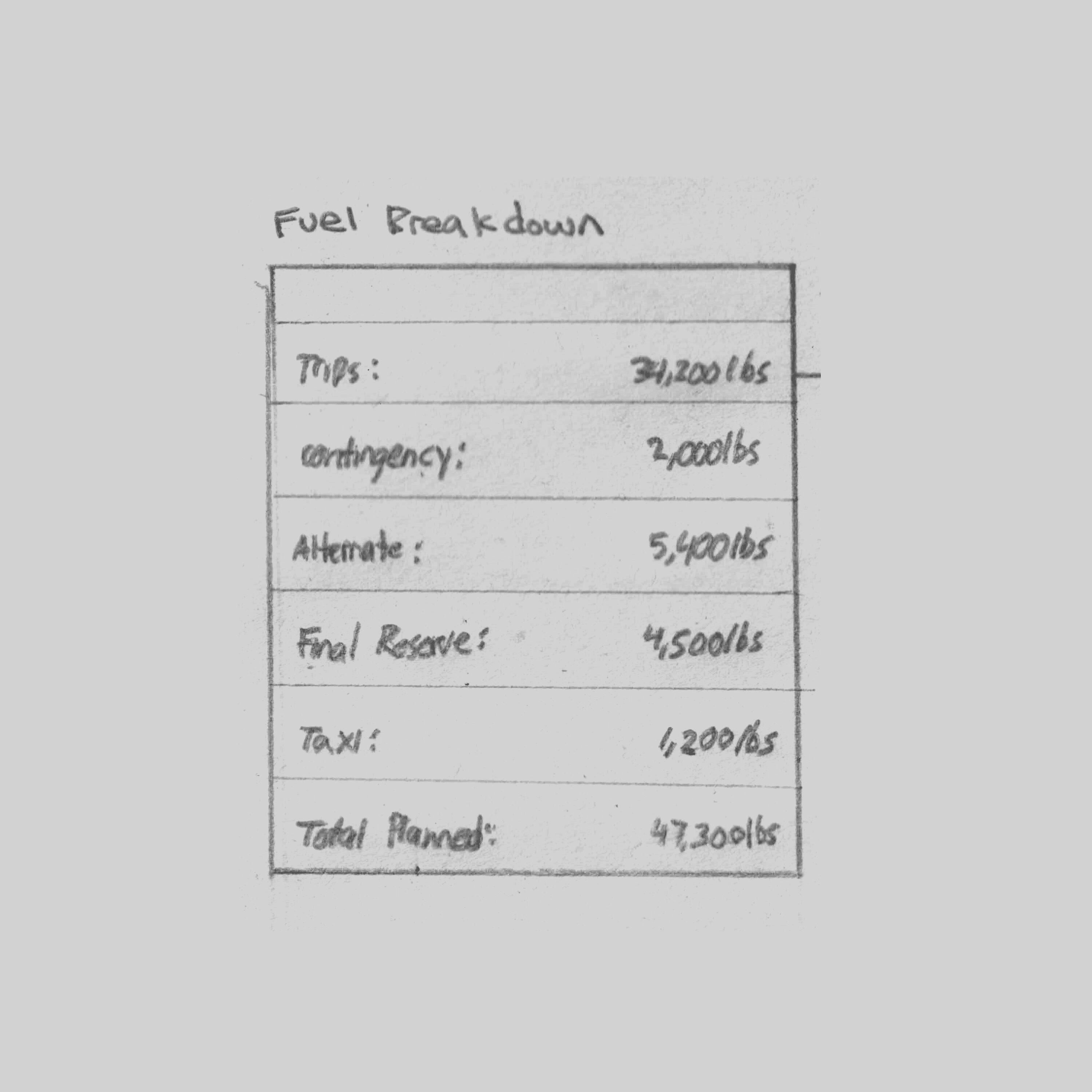
04. Auto-Calculating Fuel & Performance
No manual math. No regulatory uncertainty.

Fuel, weight, and performance are calculated automatically and checked against regulatory limits in real time. Dispatchers see a clear compliance status for each value — no mental math, no cross-referencing against printed tables.
Rationale:
Fuel compliance errors were among the most consequential in the legacy workflow — and the hardest to catch because they required mental arithmetic under time pressure. Automating the calculation and surfacing the result in context removes both the error vector and the cognitive load simultaneously.
05. Gated Submission with Required Acknowledgements
You can't release what isn't ready.

Flights cannot be submitted until all steps are validated and acknowledgements are confirmed. A compliance timer tracks regulatory deadlines and escalates visually as risk increases. The wizard doesn't block dispatcher authority — it ensures that authority is exercised with full information.
Rationale:
The gate isn't about distrust. It's about matching the interface to the legal reality — a flight release is a binding document. Making submission contingent on completion means the tool and the regulation say the same thing. Dispatchers retain full override authority, but they have to make a deliberate choice to proceed with unresolved items.